
Industrial Hemp Sustainability: Carbon Sequestration, Soil Health & Green Building
Why Industrial Hemp Is Becoming a Serious Sustainability Material
Sustainability gets talked about a lot — but not all “green” materials actually move the needle.
Industrial hemp is gaining attention because it tackles sustainability from multiple angles at once: carbon capture, land efficiency, soil health, building performance, and supply chains. When it’s grown and processed correctly, hemp isn’t just less bad than conventional materials — it actively improves systems that are under pressure.
Let’s break down why industrial hemp is increasingly being treated as a serious sustainability material.
Hemp is a fast, efficient carbon sink
Plants capture carbon — that’s not new. What makes industrial hemp different is how fast and how much carbon it captures within a single growing cycle.
During one harvest window (roughly 90–120 days), hemp rapidly converts atmospheric CO₂ into usable biomass, storing carbon in both its stalks and root system. Research consistently shows that an acre of industrial hemp can sequester approximately 9 tons of CO₂ per growing cycle, with around 40% of the plant’s dry biomass composed of carbon (External source: peer-reviewed hemp carbon sequestration studies).
On a hectare scale, hemp absorbs roughly 11 tonnes of CO₂ into its stems, with another ~6 tonnes transferred into the soil through its roots, improving long-term soil carbon storage.
That speed matters.
Trees also store carbon — but they take decades to mature. Hemp captures and stores carbon in four months, and it can be harvested annually without permanent land conversion or deforestation. This makes industrial hemp one of the few materials that can repeatedly remove carbon from the atmosphere on an agricultural timeline.
More material, less land
One of the least discussed sustainability challenges is land efficiency.
To produce the same volume of usable building material, research indicates that roughly 15,000 acres of hemp or grass can replace the output of approximately 140,000 acres of managed timber — a nearly 9× efficiency advantage
As demand for housing, insulation, and construction materials increases, land efficiency becomes just as important as carbon metrics. Industrial hemp produces usable biomass quickly, repeatedly, and on existing agricultural land — not forests — reducing pressure on ecosystems already under strain.
What hemp does for soil while it grows
Deep roots, better structure
Industrial hemp develops a deep taproot system, typically extending 30–60 cm into the soil, which helps aerate compacted ground, improve water infiltration, and reduce erosion. This root structure leaves soil in better condition for subsequent crops, which is why hemp is often described as a regenerative rotation crop, not just an extractive one.
Natural weed suppression
Hemp grows rapidly and forms a dense canopy early in the season. That canopy blocks sunlight to competing weeds, reducing herbicide pressure and lowering overall chemical inputs. Over time, this leads to healthier soils and lower environmental impact across crop rotations.
Phytoremediation potential
Industrial hemp has also demonstrated the ability to absorb heavy metals and certain contaminants from degraded soils through phytoremediation. While hemp grown for remediation cannot enter food markets afterward, it remains valuable for fiber, hurd, and industrial applications — making it one of the few crops that can both restore land and produce economic value.
Sustainability doesn’t stop at the field — buildings matter too
A significant portion of global emissions comes not just from construction, but from building operation over time.
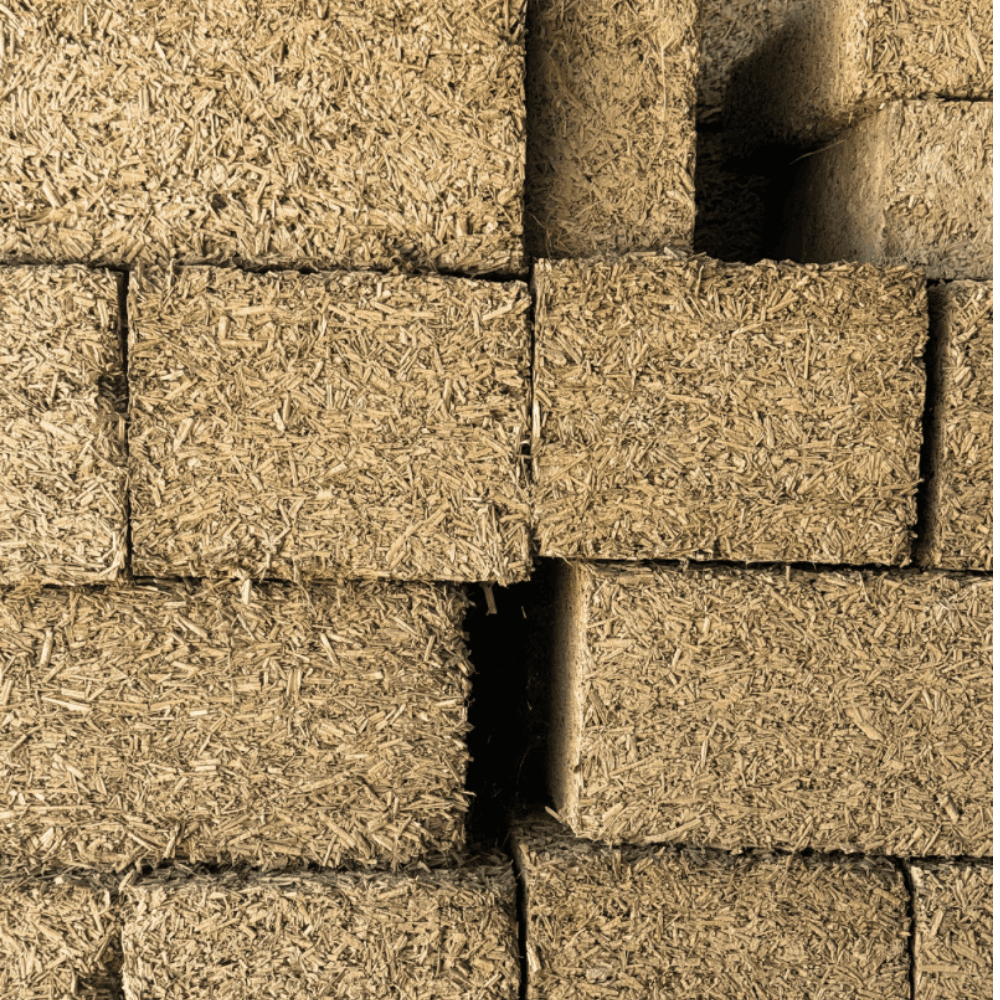
Hemp-based building materials such as hempcrete (hemp-lime) and hemp fiber insulation improve sustainability on both fronts. Their high thermal inertia allows them to store and slowly release heat, while their hygroscopic properties help regulate indoor moisture levels.
Studies have shown that these characteristics can reduce residential heating and cooling demand by 10% to 45%, depending on climate and building design. Lower operational energy use over decades translates directly into lower lifetime carbon emissions.
Does the carbon actually stay locked away?
Yes — when industrial hemp is used in durable materials, the carbon it captures does not immediately return to the atmosphere.
Instead, that carbon remains physically stored in wall assemblies, insulation, blocks, and panels for the entire lifespan of the structure. This is why hemp construction is often described as a form of “useful carbon storage” — the carbon is locked into the built environment rather than offset elsewhere.
Why the binder matters more than people realize
Not all hemp-based materials are carbon-negative — and the difference often comes down to the binder.
If hemp is combined with large amounts of Portland cement, the emissions from cement production can significantly offset the carbon benefits of the plant. Cement manufacturing alone accounts for roughly 8% of global CO₂ emissions.
Formulations that rely on lime-based binders, low-cement mixes, or no-cement systems preserve hemp’s carbon advantage and consistently demonstrate net-negative or low-carbon performance over their lifecycle.
This distinction matters — and it’s why not all “hempcrete” performs the same environmentally.
Fire resistance, durability, and longevity
Hemp-lime wall systems are often described as fire resistant — and that description is accurate.
In fire conditions, hemp-lime materials tend to char rather than flame, while lime binders create a mineralized, high-pH environment. Properly engineered assemblies can achieve 1-hour or 2-hour fire ratings under ASTM E119 standards.
That same mineralization process makes hemp-lime resistant to mold, unattractive to pests, and durable over long time spans. Longevity is sustainability — replacing materials every 20 years is not.
Why supply chain location is a sustainability issue
For years, much of the world’s hemp fiber and hurd supply was imported from overseas, often from Europe or China. That meant higher transport emissions, longer lead times, and inconsistent quality.
Heavy biomass moved across oceans carries a significant carbon cost. Domestic sourcing reduces transport emissions while strengthening regional supply chains and agricultural economies.
Pure Industrial works with U.S.-grown industrial hemp to supply fiber and hurd into construction, insulation, and industrial applications — reducing embodied carbon and supporting localized production.
A note on carbon credits and certifications
The science behind hemp’s sustainability benefits is well-established, but financial systems are still catching up.
Carbon credit programs require rigorous measurement, verification, and standardized accounting. While companies are actively working to quantify soil carbon and biomass storage, carbon credits should be viewed as an emerging opportunity, not guaranteed revenue.
Similarly, not all hemp products are USDA Organic, B-Corp certified, or third-party verified. Those distinctions matter when sustainability claims are being made.
The real sustainability takeaway
Industrial hemp isn’t sustainable because it sounds good.
It’s sustainable because it grows fast, uses land efficiently, improves soil health, captures carbon quickly, stores that carbon in long-lasting materials, reduces building energy use, and can be grown and processed locally.
When done right, industrial hemp doesn’t just reduce harm — it actively improves the systems it touches. That’s why it’s increasingly being taken seriously, not as a trend, but as infrastructure for a lower-impact future.