
Hemp Hurd Uses in Construction, Animal Bedding & Agriculture
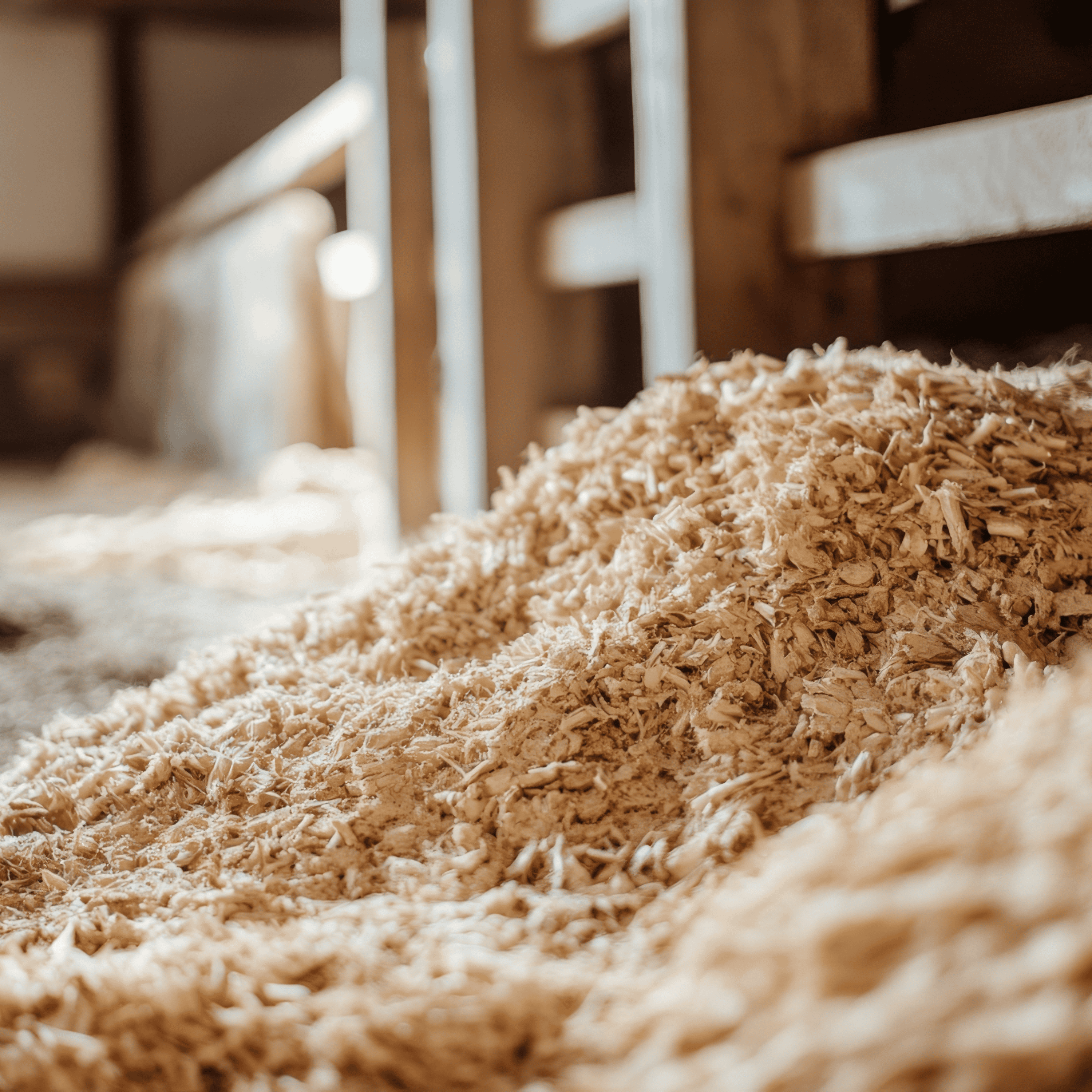
If you’ve spent any time around industrial hemp, you’ve likely heard the word hurd — sometimes called shivs or hemp straw — mentioned without much explanation.
For years, hemp hurd was treated as a secondary material left over after fiber extraction. Today, that framing is outdated. Hemp hurd is becoming one of the most commercially valuable parts of the plant, used intentionally in animal bedding, hemp-lime construction, landscaping, and agricultural systems.
Understanding what hemp hurd is — and how it differs from hemp fiber — is key to understanding why demand is rising.
What hemp hurd actually is (and what it isn’t)
Hemp hurd is the woody inner core of the industrial hemp stalk. Botanically, it is the plant’s xylem tissue — the rigid structure responsible for transporting water and providing support.
It is not fiber. It is not used in clothing. And it behaves very differently from the outer bast fiber layer.
In fact, hemp hurd makes up the majority of the dried stalk by weight, often around seventy-five percent. That volume alone explains why modern processors treat it as a primary material rather than a byproduct.
Hurd is lightweight, porous, and woody. Those physical traits are exactly what make it valuable.
How hemp hurd is produced
After harvest, hemp stalks undergo decortication — a mechanical separation process that divides the outer bast fiber from the inner core.
Historically, the focus was on extracting fiber. The hurd was secondary. Today, quality processors handle hurd intentionally, controlling particle size, dust levels, and consistency.
Clean hemp hurd has minimal fine dust and uniform shiv sizing. Poorly processed hurd contains excess dust and inconsistent fragments, which limit its use in bedding and construction systems.
Processing discipline is what transforms hemp hurd from agricultural residue into a commercial material.
The properties that make hemp hurd useful
Hemp hurd is used widely because of how it behaves physically.
It is highly absorbent, capable of holding multiple times its own weight in moisture. That characteristic alone drives much of its adoption in animal bedding and moisture-managing construction materials.
It is lightweight and porous. With a low bulk density compared to traditional aggregates, hurd traps air within its cellular structure. That porosity contributes to insulation performance, moisture buffering, and odor control.
It is biodegradable. Unlike synthetic bedding or long-lasting wood chips, hemp hurd breaks down naturally and composts efficiently, making it compatible with soil systems and regenerative practices.
Where hemp hurd is used today
Hemp hurd is no longer confined to niche markets. It is already integrated into several industries.
In animal bedding, hurd is used in horse stalls, poultry operations, and small animal habitats. Its high absorbency reduces standing moisture, which in turn helps control ammonia and odor. Because it absorbs liquid rather than letting it pool, many users report reduced bedding turnover compared to pine shavings.
In construction, hemp hurd serves as the aggregate component in hemp-lime systems, often referred to as hempcrete. When mixed with a lime-based binder and water, hurd creates a lightweight composite used in wall infill and insulation assemblies. In this context, hurd is not structural on its own. It functions as a breathable, insulating core within a framed wall system.
In landscaping and gardening, hemp hurd is used as mulch, ground cover, and compost input. It suppresses weeds, retains soil moisture, and decomposes over time into organic matter rather than persisting as waste.
Across these applications, the same traits — absorbency, breathability, and biodegradability — drive adoption.
Construction clarity: hempcrete and code recognition
It is important to clarify that hemp hurd does not replace concrete foundations or structural framing. Hemp-lime systems are typically non-load-bearing and rely on wood or steel framing for support.
What hurd provides is a lightweight, vapor-permeable infill material that helps manage moisture and temperature fluctuations within wall assemblies.
Recent adoption of hemp-lime provisions in building codes, including Appendix BL in the International Residential Code, has formalized this use and reduced regulatory uncertainty in states that adopt the framework.
This shift from “alternative material” to a codified system has accelerated interest from builders.
How industries describe hemp hurd
Across bedding suppliers, builders, and agricultural users, several themes repeat.
In animal systems, absorbency and low dust are emphasized because they improve respiratory conditions and reduce odor.
In construction, breathability is highlighted because hemp-lime assemblies allow vapor diffusion instead of trapping moisture.
In landscaping, compostability matters because the material returns to the soil without long-term residue.
And increasingly, domestic sourcing is emphasized. Processors and buyers prefer U.S.-grown hemp hurd for consistency and supply reliability.
The messaging differs by industry, but the material properties remain the same.
Important clarifications
Hemp hurd is versatile, but it has boundaries.
Fire resistance in hemp-lime systems applies to complete wall assemblies, not loose hurd. Dust levels depend on processing quality. While safe for most animals, certain reptiles may require alternative substrates. And industrial hemp, by legal definition, contains less than 0.3% THC and has no psychoactive effects.
Clear expectations are what make the material successful.
Why bulk hemp hurd sourcing matters
Hemp hurd is used at scale. Animal bedding operations move it by the pallet. Construction systems use it by the cubic yard. Landscaping applications require steady supply through growing seasons.
For these industries, consistency matters more than novelty. Particle size, cleanliness, and moisture levels must be predictable.
Pure Industrial supplies bulk hemp hurd sourced from Virginia-grown hemp, supporting bedding operations, construction material producers, and agricultural uses. Reliable supply chains turn hemp hurd from an interesting alternative into a dependable industrial input.
The takeaway
Hemp hurd is no longer a secondary byproduct.
It is an absorbent, lightweight, biodegradable material already embedded in bedding systems, hemp-lime construction, and soil management practices. As domestic processing improves and supply chains stabilize, hemp hurd is becoming one of the clearest examples of industrial hemp’s practical value.
In many cases, the difference between theory and adoption comes down to one thing: access to clean, consistent bulk hemp hurd.